REVIEW
Brahms: Piano Concertos Nos. 1 & 2
Grandeur, warmth and a finely judged sense of scale.
Read the review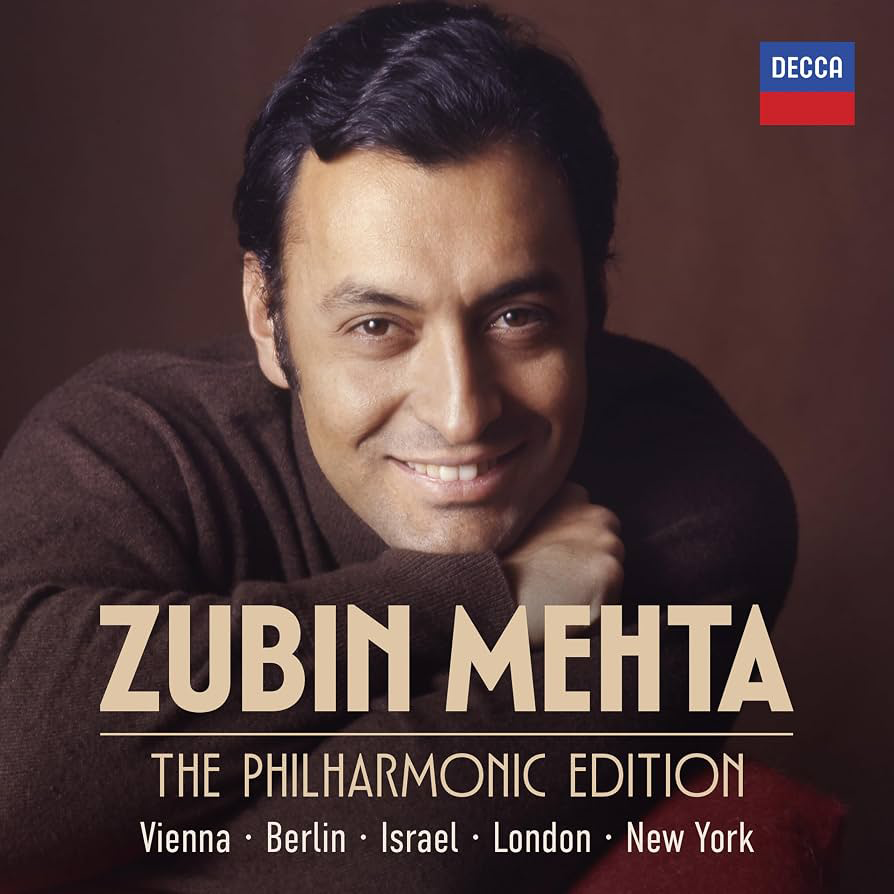
A survey of Mehta’s Decca and Deutsche Grammophon recordings, tracing a lifetime of collaboration with the world’s great orchestras.
Source: Gramophone ↗
In the years leading up to the 90th birthday of Zubin Mehta last April, several labels have reissued portions of his substantial legacy on record. Most artistically satisfying of them has been Decca’s 38-disc box-set dedicated to his 17‑year tenure as Music Director of the Los Angeles Philharmonic (10/20). This ‘Philharmonic Edition’ sweeps up most of his other recordings for Decca (and DG), including not-so-philharmonic Puccini with the Royal Opera and Verdi with the Maggio Musicale of Florence. But who cares about titles, anyway? While inevitably less consistent in quality, the set reflects the conductor’s longevity of career – spanning Bruckner in 1965 to Brahms in 2013 – and to his ability, throughout that time, to hold the hard-won respect of the world’s great orchestras.
Mehta studied in Vienna with Hans Swarowsky, notoriously skipping choir rehearsals with his fellow student Claudio Abbado, and has always considered himself a Viennese musician by both training and musical inclination. Within a generously annotated booklet it is claimed that Mehta first conducted the VPO in 1957 and first recorded with them in 1967. In fact their first concert together took place in 1961, and their first sessions in 1965: a version of Bruckner’s Ninth that has rarely left the catalogue since.
This Ninth would not pass muster nowadays, for its smudgy ensemble and sometimes crudely overbearing brass. But it has line as well as an imposing profile: a thread of melody and argument which, as a virtue, endures beyond evolving notions of style. Finding this thread in the autobiographical, cyclical Fourth Symphony of Franz Schmidt was one of Mehta’s most enduring achievements on record at a time when it took a relatively young but accomplished and Viennese-trained musician to make a persuasive case for music which had never travelled well outside Austria and Germany.
Schmidt’s Fourth is paired here with the Philadelphia Symphony of Gottfried von Einem, a punchy, concise and neoclassical three-movement piece which very partially bears witness to the spirit of adventure shown by Mehta in Vienna. You would scarcely guess, from this box or any other, that he conducted the VPO in Messiaen’s Oiseaux exotiques, Stockhausen’s Jubilee and Crumb’s Ancient Voices of Children. Labels have been frustratingly reluctant to document Mehta on his adopted home turf, in Viennese accounts of the Brahms and Strauss works which largely define the conductor as a recreative musician. The reissue here of a Brahms First Symphony from 1976 rekindles happy memories of Mehta and the VPO in concert, and in complete, apparently intuitive rapport.
In a bland and ghost-written memoir (The Score of My Life – Amadeus: 2006), Mehta remarks: ‘I think of myself much more as a coordinator, sometimes also as a supervisor, but most of all as a communicator.’ That this claim isn’t faked humility on his part is borne out by the length and amity of his relationships with leading orchestras, and with leading colleagues such as Daniel Barenboim; also by the character of the recordings in this box, on the whole.
When the announcement was made of Franz Welser-Möst’s imminent departure from the Cleveland Orchestra, its associate concertmaster Jung-min Amy Lee remarked that The Cleveland doesn’t respond well to conductors who come with ‘preconceived ideas’ about a score, whereas Welser-Möst ‘is really in the moment, collaborating with us and understanding the potential of what this group is able to do’. As listeners and third-party observers, we may often underestimate the value that orchestras place on such respect shown by those musical leaders, especially in the modern era, who bring discipline and authority to rehearsals without dictating every last detail of a performance. From an older time, it was said of Beecham by his musicians that ‘he lets us play’.
All this is true of Mehta, even in the symphonies by Mahler which appeal to listeners as conductors’ music above all. In that sense, his most notable successors among younger conductors are Andris Nelsons and Klaus Mäkelä, who inspire affection and establish rapport with their musicians by their organised approach to rehearsals, and, quite simply, by knowing what they are doing. Mehta’s IPO recordings of Nos 1 and 4, and the VPO recording of No 2, unfold without exaggerated voice-leading or wild extremes of tempo and dynamics.
The challenge issued to listeners by such a collaborative approach is to refrain from looking for idiosyncratic or individualistic takes on standard repertoire which are so often defined and marketed as the product of a single interpretative imagination. Three years after that notable Brucknerian debut on record, in June 1968, Mehta recorded Dvořák’s Seventh and Tchaikovsky’s Fifth Symphonies at Kingsway Hall in London, while on tour with the Israel Philharmonic. Mehta has often maintained that the Dvořák is especially difficult – perhaps for its metrical complexity – and this muscular but songful account harnesses the charismatic wind-playing of musicians who would have in many cases had Bohemian and/or Slavic blood in their veins.
Collectors of such boxes, on the hunt for discographic rarities, will find several more IPO-made albums answering to their desires. Two Mozart collections exemplify the unpredictable level of engagement which makes the set a curate’s egg. The Andante of Symphony No 34 lacks nothing for silvery elegance, with the outer movements vitally energised to a degree that makes the pedestrian phrasing of No 40 all the more perplexing. No 39 picks up purpose after a sleepy introduction, with the clarinet often more prominent than trumpets and drums.
Rarer still is the album-length (but not complete) version of Beethoven’s ballet The Creatures of Prometheus, recorded in Rome in 1969. Where some of the IPO albums are compromised by the flat acoustic of their home at the Fredric R Mann Auditorium, the Decca engineers and Mehta between them capture a fiery, quasi-symphonic drama in Beethoven’s score. Along the same lines, the early instalments of a Schubert cycle draw the best out of the IPO’s cultivated string section, with springy rhythms in the quick movements bearing a resemblance to Abbado’s later COE cycle on DG more than (for example) to Böhm or Karajan in Berlin. An expanded version of Mendelssohn’s Octet celebrates this IPO string sound, while inevitably sacrificing some flexibility for unanimity. Another high point of the IPO/Mehta partnership is the set’s opening album, of Bartók’s Hungarian Pictures and Concerto for Orchestra, both inflected with knowing charm and (like their Mahler) a relaxed affinity with the folk culture which shaped their composers’ minds.
Mehta swapped Los Angeles for New York, with Isaac Stern reportedly influential behind the scenes, but contractual issues prevented Decca from recording them together beyond a single album of Berlioz’s Symphonie fantastique, apparently captured on a single day in October 1979 at the acoustically unlovable Avery Fisher Hall. Even in such circumstances, and in early digital sound, the comparison with his CBS recordings in New York decisively favours Decca, for a depth of sound-stage which evokes distance and loneliness in the ‘Scène aux champs’ as much as luridly gothic horror in the finale.
In his amiable way, Mehta has discussed his principally supportive role in concertos, and his responsibility (as he sees it) to mould the orchestra around the soloist even when he has different ideas about how the music should go. Comparing Mehta’s VPO support of Vladimir Ashkenazy in Beethoven’s piano concertos with Horst Stein’s conducting of the same orchestra with Friedrich Gulda, also captured by Decca in the ’70s, I find ‘Kapellmeister’ Stein far more positive both in shaping the tuttis and in quick-witted response to the pianist. Another Beethoven cycle finds Mehta back with the IPO, accompanying Radu Lupu, where again the pianist (and the concertos) deserves more assertive collaboration. Much more involving are the partnerships with Arthur Rubinstein (in Brahms’s First Concerto), with the violinists Boris Belkin and Sayaka Shoji (both in Paganini’s First Concerto, 24 years apart), and with David Garrett in Brahms once more.
Mehta has always been a man for a big occasion, conducting Mahler’s Symphony No 2 in Masada, Tosca (and the Three Tenors) in Rome and Turandot in Beijing. This ‘Philharmonic Edition’ reaches a fitting close with two more such events, a 1998 tribute to the memory of Georg Solti in London and excerpts from the 1982 Huberman Festival in Tel Aviv. Mehta’s violinist friends took centre stage, while he offered buoyant and keenly attentive support to Isaac Stern, Pinchas Zukerman, Shlomo Mintz and Itzhak Perlman in a portmanteau Four Seasons, with Perlman and Zukerman dovetailing smoothly in the Concertone and Sinfonia concertante by Mozart. Perhaps contractual difficulties dictated the exclusion of Sibelius’s Violin Concerto in a gripping account given by Ida Haendel at the same festival, included in the 2020 box of her Decca recordings.
In his memoir, Mehta recalled how ‘Swarowsky always preached that a conductor had to place his technique at the service of the orchestra’. He would never have claimed, as Bernstein did, that he needs to feel in the moment as though he had composed the music himself. For all the glamour surrounding Mehta’s reputation, the best recordings in this box – a good many of them – are graced with a humility, as well as a confidence in musicianship, that stands the test of time.